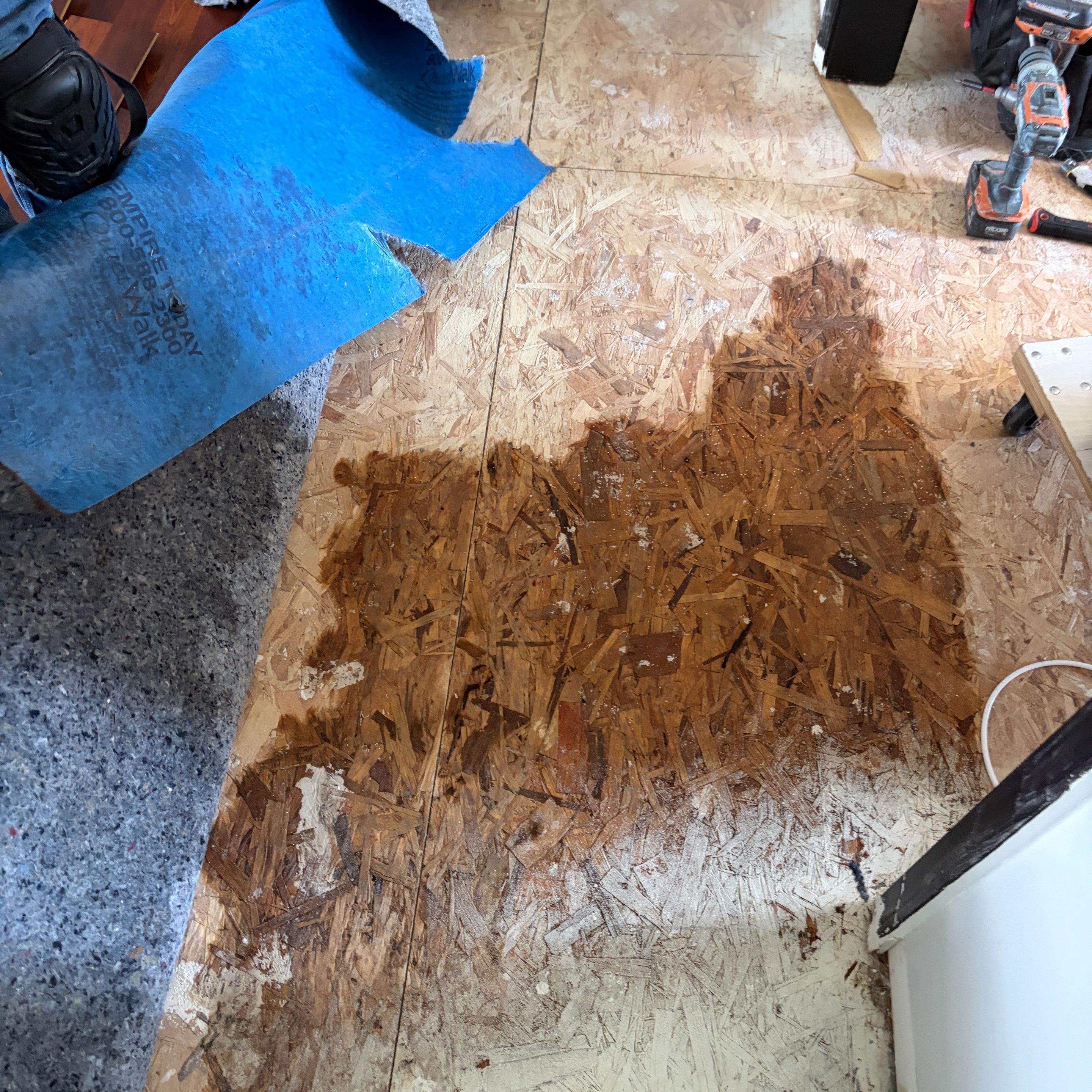
The Slow Leak That Cost a Homeowner $14,000
One Clay City family called us in October about a cold draft and a strange odor in their guest bedroom. They thought it was a dead mouse. When our IICRC certified tech popped the crawl space hatch, he found about 800 square feet of standing water roughly two inches deep, fed by a slow supply line drip at the water heater that had been running for an estimated four to six months. The vapor barrier had become a pond liner, trapping every drop.
The moisture meter readings on the subfloor were above 28 percent, which is well past the threshold where wood begins to lose structural integrity. Mold colonies were already visible on three joists. We pulled 14 truckloads of saturated insulation, ran four submersible pumps and a truck mount extractor for about six hours, and set 12 air movers with two LGR dehumidifiers running for seven days. Total invoice landed near $14,000. Insurance covered roughly 70 percent because the leak was sudden and accidental under their policy language, even though the duration was long. We helped document the claim with moisture maps and thermal imaging, which is the kind of paperwork adjusters actually want to see.
The detail that stuck with our crew lead on that job was the homeowner's reaction when we walked him down the hatch ladder with a flashlight. He had lived above that crawl for eleven years and never once looked in it. That is the rule, not the exception. Most Clay City homeowners we meet have never set foot in their own crawl space, which is exactly why a slow leak can run for half a year before anyone notices. We always recommend a quick visual check twice a year, spring and fall, even if it is just a flashlight pointed through the hatch from the top step.
What We Actually Do Under There
Every crawl space job at Clay City Water Restoration follows the same field sequence, but the timeline shifts based on what we find. A Clay City rental property owner in a flood-prone pocket near the creek called us after heavy rain pushed groundwater through his block foundation. His crawl was Category 2 water (gray water from outside soil contact), not a simple clean supply leak. That changes the protocols. We treat the framing with an EPA registered antimicrobial, and we do not reuse the vapor barrier.
Here is the general flow when we arrive:
- Inspection with moisture meters, thermal cameras, and a hygrometer reading of the crawl space air
- Water extraction using submersible pumps for standing water and truck mount units for saturated material
- Removal of contaminated vapor barrier, insulation, and any unsalvageable debris
- Antimicrobial treatment on joists, subfloor underside, and foundation walls
- Structural drying with air movers and dehumidifiers, monitored daily until wood reaches 15 percent moisture or below
- Reinstallation of new 10 to 20 mil vapor barrier, often with seams taped and edges sealed to the foundation
Most jobs run three to seven days for the drying phase. If you are dealing with the source first, our team also handles hidden leak detection behind walls and under floors so we are not just drying water that is going to come right back.
The First 24 Hours Matter More Than People Think
A young couple in Clay City called us on a Saturday morning, about six hours after spotting a small puddle near their crawl space access door. They almost waited until Monday. We talked them through it on the phone, and they agreed to let us come look. Good thing. The water turned out to be coming from a cracked drain line, and the crawl already had close to 200 gallons pooled in the low corner. Because we got dehumidifiers running that same afternoon, the wood never crossed the 20 percent moisture threshold and no insulation needed replacement. Final invoice was under $3,000. Same situation, waited 48 more hours, easily doubles or triples. Speed is the single biggest variable in what these jobs cost.
What It Costs in Clay City
Crawl space water removal and drying in Clay City generally runs between $2,500 and $9,000 for residential jobs, with the bulk of projects landing in the $3,500 to $6,000 range. Heavy contamination, large square footage, or extensive insulation replacement push the number higher. Insurance usually covers sudden and accidental events. Long-term seepage and groundwater intrusion are often excluded, which is why prompt response saves both your structure and your claim.
Why Mold Shows Up Fast in Crawl Spaces
Mold needs three things: moisture, organic material, and temperatures between roughly 60 and 90 degrees. A Clay City crawl space in summer hits all three within 48 to 72 hours of water intrusion. Wood joists, paper-faced insulation, cardboard from old ductwork wraps, even dust, all of it feeds spores. We have walked into crawl spaces in July where the water had been sitting nine days and the mold was already visible from the hatch. Drying alone will not solve that. The affected materials have to come out.
This is where being honest matters. If we open your hatch and find structural damage beyond what drying can fix, we will tell you directly. Sometimes the answer is a contractor for sistered joists, not just a restoration crew. We would rather lose a job than sell you a service that does not actually fix the problem. If full water damage restoration is the right call across multiple areas of your home, we will scope it that way and document everything for your insurance.
When Crawl Space Water Is Really a Basement Problem
A homeowner in an older Clay City neighborhood, one of those 1940s builds with a partial basement and a partial crawl, called us after his sump pump failed during a March storm. The basement side was obvious, ankle deep water, ruined boxes, the works. What he did not realize was that the crawl side, separated by a short knee wall, had taken on just as much water but had nowhere to drain. We worked both spaces simultaneously, and the crawl actually took longer to dry because the airflow was so restricted.
If your situation looks more like a basement event than a pure crawl space leak, our sump pump failure and basement flooding guide walks through the parallel decisions you will face. The drying physics are the same, but the access and equipment placement are different.